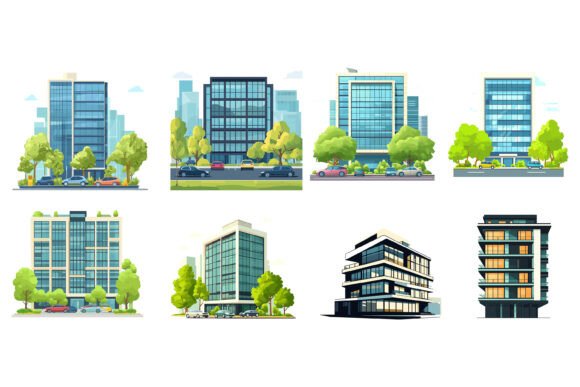
Buildings as Visual Anchors: Integrating Architectural Illustrations into Your Daily Creative Work
High-quality building illustrations serve as more than decorative elements. They become spatial shorthand in a design, conveying stability, growth, community, or innovation without a single word of copy. The AI EPS illustration set centered on buildings offers a thoughtfully crafted collection that fits directly into the practical routines of graphic designers, UI/UX specialists, marketing leads, and content creators. Because the set includes both AI EPS and JPG formats, it immediately slots into workflows that span vector-intensive software like Adobe Illustrator as well as quick-placement tasks in presentation tools or web builders.
What makes a building-focused asset library truly usable is its structure. When every file is neatly organized with labeled layers and intuitive grouping, you skip the tedious step of ungrouping dozens of anonymous paths. You open a file, locate the roof, windows, or facade elements, and start customizing. This level of preparation aligns with how professionals actually work: under deadline, moving between multiple projects, and needing assets that adapt rather than demand workarounds.
Where Building Assets Fit into a Broader Creative Process
Anyone who builds visual stories—whether for a website hero banner, a municipal report, or an educational app—knows that imagery anchors meaning. Architectural illustrations ground abstract concepts like "infrastructure," "real estate growth," or "urban planning" in a form that audiences instantly recognize. The collection can be used before a project starts, as part of mood boarding and style exploration. Placing a few clean vector buildings on a canvas alongside color swatches and typography helps stakeholders visualize the tone of a campaign long before final photography or custom illustration is commissioned.
During production, building assets act as adaptable placeholders or final components. In a multi-page brochure covering urban development, replacing rough grey boxes with polished, editable AI vectors helps the layout team judge spacing and hierarchy more accurately. After delivery, the same assets often resurface in revised formats—resized for social media graphics, recolored for an updated brand palette, or simplified into icon sets for an app interface. Because the files are built with perfection in details and consistency, you can revisit them months later and still expect predictable output across print and digital media.
Preparing Your Workspace and Understanding File Compatibility
Before integrating any new asset pack into a production environment, it helps to verify system compatibility and set up a logical library location. The set is designed for Mac and Windows users, a critical detail when collaborating across mixed-OS teams. AI (Adobe Illustrator native) and EPS (Encapsulated PostScript) files open in a wide range of professional vector applications, while the included JPGs give you immediate previews or raster versions for quick placements in Word documents, email newsletters, or slide decks.
On either operating system, designate a master folder within your asset library. Organize subfolders not only by file type but by building category—residential, commercial, governmental, mixed-use—if the collection supports thematic sorting. The neatly organized file and layer structure inside each document pairs seamlessly with a clean folder hierarchy outside it. When you later search for a specific hospital or storefront icon, you reduce retrieval time from minutes to seconds.
Practical Ways to Use Building Vectors Across Different Mediums
The versatility of these building illustrations becomes evident once you map them to real tasks. Here are several roles where the integration proves most productive:
- Print collateral: Flyers, brochures, and annual reports benefit from vector buildings that maintain crisp edges at any scale. Because the illustration set is suitable for print, you avoid the pixelation risk that comes from scaling rasterized clip art. Layered files let you separate line work from fills to create overprinting or varnish plates when preparing files for commercial presses.
- Web and mobile interfaces: In app onboarding screens or real estate marketplace listings, building icons and small scenes communicate function quickly. The ability to edit, change colors, and modify icons easily means a green hospital icon can become blue to match a secondary palette in seconds. You maintain a consistent visual language across multiple breakpoints without redrawing from scratch.
- Symbols and infographics: Urban statistics, demographic data, and transportation charts often rely on building silhouettes as markers. The precision of these vectors ensures that symbol families retain identical line weights and proportions. When building infographics, you can combine multiple structures into a cityscape then add data callouts around them without clashing styles.
- Presentations and pitch decks: Educators explaining city planning, entrepreneurs pitching a new construction tech, or nonprofit directors illustrating community programs all benefit from polished visuals. Instead of default clip art, pull in a vector courthouse or school building, adjust its color to complement the slide master, and use it to anchor key bullet points. The JPG versions serve as lightweight fallbacks when sharing via platforms that don't support AI file previews.
Integrating Buildings with Other Design Tools and Resources
Real creative work rarely happens inside a single application. You might sketch a layout in a notebook, place temporary JPG building graphics into a Figma wireframe, then finalize components in Illustrator. The AI EPS files slot into this chain smoothly. Open the vector version, copy the building group, and paste directly into Photoshop as a smart object for further compositing with photography. Place the EPS into InDesign for a multi-page document where the buildings function as repeating section dividers. In presentation software like PowerPoint or Keynote, the JPG previews often suffice, but you can also bring in the vector file via SVG conversion for animated builds.
Consistency matters when multiple people touch the same project. A design team can create a shared library of brand-adjusted building assets inside their Creative Cloud workspace. Because the original files allow deep editing, the lead designer can set the primary color palette, simplify complex roof details for smaller icon usage, and save those versions as separate AI files. Then, writers, social media managers, and junior designers can use the pre-styled assets without risking off-brand colors or distorted proportions.
Editing and Customizing Buildings for Brand and Context
The true value of a well-built vector set comes out when you need to adapt, not just place. Every building in a composition might need to feel part of the same neighborhood, even if you’re pulling from different parts of the collection. The consistency in details—stroke widths, corner styles, window grid patterns—means you can recolour components without awkward mismatches. Use the direct selection tool to isolate the facade’s main fill, apply your brand’s primary color, and watch it carry through all windows and architectural details that share that swatch.
Often, you’ll need to modify structures for specific messaging. A factory building intended for a heavy industry brochure might need a smaller smoke stack or an added solar panel for a sustainability report. Since the artwork is editable and built with a sensible layer structure, you can find the relevant elements, tweak curves, add or remove details, and still preserve the overall style. Non-destructive edits—like using appearance panels for recoloring rather than breaking paths—keep the asset reusable for future projects with different requirements.
Organizing Your Archiving System for Long-Term Efficiency
Over time, a single asset pack can serve dozens of projects, but only if you can locate the right file when you need it. The set’s neatly organized file and layer structure is a starting point; you extend that discipline into your own storage. Consider using a naming convention that pairs the building type with its primary usage context: Commercial_Storefront_Corner, Residential_Apartment_MidRise, Civic_Library_FrontView. Add color variant suffixes only where you’ve already customized a file and saved it as a separate asset. This prevents the archive from ballooning with minor variations that could easily be recreated from the master.
When collaborating through cloud storage, include a text file or layered document that shows a visual index of all building assets with their file names. Anyone searching for an “urban skyline” doesn’t have to open two dozen files to find the one with the appropriate density. The initial time spent on indexing repays itself the first time a team member jumps onto a project without needing a briefing on asset locations.
Quality Control, Scaling, and Output Considerations
Vector building illustrations offer inherent scalability, but responsible output preparation goes beyond the file format. For large-format printing such as trade show banners or building wraps, open the AI file and verify that embedded patterns or effects do not rely on raster settings that limit output resolution. Even with vectors, complex gradients or drop shadows can contain rasterized data; review the Document Raster Effects Settings before sending to print. For screen use, exporting at various densities (1x, 2x, 3x) from a single master vector gives you crisp results across all screens.
The inclusion of JPG files isn’t just for convenience—it’s a fallback for contexts where vector formats create friction. When dropping an image into a web-based editor that only accepts raster uploads, the JPG gets the job done immediately. Just keep the master AI file handy for any situation where you’ll resize significantly or need transparency. Having both formats reduces the temptation to stretch a JPG beyond its intended dimensions and compromise visual quality.
Real-World Workflow Example: From Concept to Multi-Channel Delivery
Imagine a small business owner creating a website and printed brochure for a new co-working space located in a renovated warehouse district. They start with a sketch of the homepage, planning to feature an illustrated streetscape as the background. Using the building vector set, they pull a row of industrial-style structures with the characteristic sawtooth roofs. They open the AI file, adjust the facade colors to reflect the actual brick and steel palette of the neighborhood, and add signage to one building that matches their logo.
That customized streetscape becomes a master asset. From it, they export a high-resolution JPG for the website hero, a grayscale EPS version for the footer of the printed brochure, and simplified icons for the mobile menu. For a series of social posts announcing the space, they extract individual buildings, recolor them with seasonal promotional colors, and pair them with event dates. The layered structure of the original file makes each variation a matter of toggling visibility and saving a new output, not redrawing or starting from a flattened image. This flow—customize once, adapt to many outputs—exemplifies how building illustrations save hours while maintaining a cohesive brand presence.
Long-Term Value and Consistent Visual Language
Selecting an illustration style for your projects is a commitment. You want assets that won’t look dated after a single season and that can be used alongside future additions. The perfection in details and consistency across this set means you can acquire additional themed packs down the line—say, transportation or landscape vectors—and they will sit comfortably next to your existing building graphics. A uniform line quality and color handling across assets let you build comprehensive scenes without a patchwork feel.
For agencies and freelancers serving multiple clients, this consistency translates to faster onboarding. Instead of proving out a new illustration style for every proposal, you can rely on a core building set as a starting point, then customize it to match the client’s brand. The knowledge that any team member can open a file and understand its layer structure also reduces bottlenecking. No one has to wait for the “design guru” to untangle a complex vector before making a simple color change.
Whether you’re assembling a presentation for a city council meeting, building an interactive infographic for a nonprofit annual report, or refreshing the blog imagery for a property management company, these building illustrations fit into a workflow that values clarity, speed, and repeatable quality. The combination of well-organized AI EPS files, Mac and Windows compatibility, and flexible editing capabilities supports the kind of seamless integration that keeps creative momentum uninterrupted. You spend less time wrestling with assets and more time shaping the visual narrative that your audience will remember.