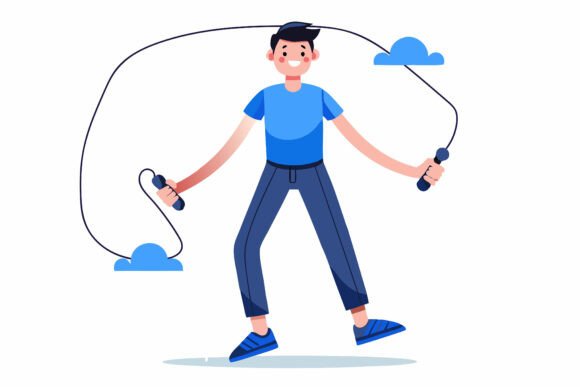
The Art of Movement: Why Jumping on Rope Illustrations Matter in Modern Design
There's something undeniably captivating about a figure suspended mid-air, rope arcing overhead in a perfect loop. Jumping on rope imagery has evolved far beyond simple fitness graphics. Today, it represents rhythm, childhood nostalgia, athletic discipline, and pure kinetic energy—all wrapped into a single, elegant motion. For designers and creatives, capturing that fleeting moment requires more than just technical skill. It demands an understanding of weight, timing, and the subtle poetry of human movement.
When you work with professional illustration sets, you're not just buying files. You're gaining access to carefully constructed visual narratives that communicate instantly. The right illustration of someone jumping on rope can transform a mundane fitness app interface into an inviting experience, or elevate a corporate wellness presentation into something memorable and human.
The Precision Behind the Playfulness
Most people see a skipping rope illustration and think "simple." But look closer. Notice how the rope's curve follows a mathematically precise arc, how the jumper's shoulders align with the hips, how the wrists flick at exactly the right angle. These aren't accidents. Jumping on rope illustrations that achieve true quality undergo meticulous refinement—each anchor point adjusted, every bezier curve massaged until the motion feels authentic, not stiff.
Vector-based artwork gives you this precision without compromise. Unlike raster images that pixelate when scaled, AI and EPS formats maintain razor-sharp clarity whether printed on a business card or stretched across a billboard. This scalability makes them indispensable for brands that exist across multiple touchpoints—from mobile screens to trade show banners.
Why Layer Structure Changes Everything
Imagine opening a file and finding hundreds of unlabeled paths tangled together like spaghetti. Now imagine opening one where every element sits neatly in named layers: "Rope_front," "Left_hand," "Right_shoe," "Shadow_ground." The difference in workflow speed is staggering. Organized file structures respect your time. They let you isolate specific components, recolor individual elements, or reposition limbs without accidentally disturbing the entire composition. For jumping on rope scenes, this means you can adjust the rope's color independently from the athlete's clothing, or modify the jumping height without rebuilding the whole figure.
This thoughtful organization extends beyond convenience. It reflects a design philosophy that values the end user's creative freedom. When artists build files with you in mind, they're essentially providing a toolkit rather than a locked-down asset. You gain the ability to iterate quickly, experiment boldly, and meet tight deadlines without frustration.
Cross-Platform Compatibility as a Non-Negotiable
We work in a fragmented digital landscape. Designers toggle between operating systems, software versions, and output specifications constantly. A file that performs flawlessly on one machine but corrupts on another isn't just an inconvenience—it's a liability. That's why professional illustration sets prioritize compatibility from the ground up. Whether you're running the latest macOS on a MacBook Pro or working with Windows on a desktop workstation, the files should open cleanly, render accurately, and export without surprises.
AI EPS formats serve as the universal language of vector graphics. Adobe Illustrator remains the industry standard, but these files also import smoothly into Affinity Designer, CorelDRAW, Figma, and countless other applications. JPG previews provide quick thumbnail browsing, letting you scan through your library of jumping on rope variations without launching heavy editing software. This practical consideration saves hours over months of regular use.
Detail Density and Visual Consistency
Amateur illustration sets often reveal themselves through inconsistencies. One figure might feature detailed shading while its companion looks flat. Hands might appear anatomically awkward in one pose but natural in another. When you're building a cohesive project—say, a fitness app that shows multiple exercise illustrations—these discrepancies undermine your credibility. Users notice, even if subconsciously.
Professional collections maintain a unified visual language throughout. The line weights stay consistent. The color palettes harmonize. The level of detail remains steady from one illustration to the next. In a jumping on rope series, you'll see the same care applied to the rope texture, the facial expression, the muscle definition, and even the way fabric folds during motion. This consistency creates trust and professionalism that reflects well on whatever brand or product incorporates the artwork.
From Print to Pixels: Versatility Across Mediums
Modern design doesn't live in a single medium. Today's project might be a printed brochure tomorrow, an Instagram story next week, and part of an interactive infographic the month after. Illustration assets need to flex across these contexts without requiring complete rebuilding. The vector nature of jumping on rope illustrations makes this adaptability possible.
For print applications—posters, magazines, packaging—vector files ensure crisp output at 300 DPI and beyond. Colors remain faithful to CMYK values, and fine details like the twisted strands of a jump rope don't blur into indistinguishable blobs. For web and app interfaces, the same files export as SVG or optimized PNGs, maintaining small file sizes that load quickly without sacrificing visual quality. Symbols and icons derived from these illustrations scale down gracefully, remaining recognizable even at favicon dimensions.
Infographics particularly benefit from high-quality jumping on rope imagery. Fitness statistics, health data, workout guides—all become more engaging when accompanied by illustrations that feel dynamic and professional. A well-designed figure mid-jump draws the eye, guides attention through data points, and creates emotional resonance that charts and graphs alone cannot achieve.
The Freedom to Customize Without Limits
Purchase decisions often hinge on a simple question: "Can I make this my own?" Stock photography and pre-rendered graphics typically answer "no"—you're stuck with the colors, compositions, and styling decisions someone else made. Vector illustrations flip this dynamic entirely. You're given the raw materials and invited to transform them according to your brand guidelines, project requirements, or creative vision.
Changing the color of a jump rope takes seconds, not hours. Need the athlete to wear your brand's specific shade of blue? Select the layer, adjust the fill, done. Want to modify the icon silhouette for a more minimalist app interface? Strip away the details, simplify the curves, and you've got a custom symbol that still reads as jumping on rope at a glance. This editability extends the lifespan of your investment—one illustration set can spawn dozens of variations across multiple projects over years of use.
Designers who've struggled with rigid stock assets understand the value of this flexibility deeply. They've spent frustrating hours trying to mask out backgrounds, adjust awkward cropping, or match inconsistent lighting. When the source files are built for modification from the start, those headaches disappear.
What Makes an Illustration Set Truly Special
Beyond the technical specifications lies something harder to quantify: care. You sense it in the small decisions. The way a character's expression conveys focus without looking strained. How the motion lines suggest speed without cluttering the composition. The subtle shadow placement that grounds the figure and prevents floating. These aren't specifications you'll find on a feature list, but they're what separates generic clip art from genuine creative resources.
The best jumping on rope illustrations feel alive. They capture that split-second when gravity hasn't yet reclaimed the jumper, when the rope is a perfect ellipse bisecting the frame, when everything hangs in beautiful tension. Achieving this requires an illustrator who understands anatomy, physics, and the particular rhythm of skipping—the slight delay between wrist rotation and rope response, the natural spinal flexion during the jump, the relaxed but ready hand position.
Integrating Movement into Modern Projects
Fitness apps have obvious use cases for jumping on rope imagery—exercise demonstrations, workout tracking interfaces, achievement badges. But the applications extend much further. Educational materials teaching coordination and physical literacy. Corporate wellness campaigns promoting desk-bound employees to move. Children's books illustrating playground activities. Event branding for jump rope competitions or community fitness challenges. Gaming interfaces for motion-controlled or fitness-oriented titles.
Each context demands something slightly different from the illustration. An app icon needs maximum clarity at minimum size. A children's book spread might benefit from more expressive, playful styling. A corporate presentation requires clean, approachable figures that don't feel childish. Having source files you can adapt means never forcing a square peg into a round hole. You tailor the asset to the audience, not the other way around.
Making the Investment Count
Time is the hidden cost in every design project. Free or low-quality assets often seem economical until you tally the hours spent fixing them, working around their limitations, or searching for alternatives when they inevitably fall short. Professional illustration sets with organized layers, cross-platform compatibility, and genuine attention to detail pay for themselves through efficiency alone. Add the creative freedom that comes from fully editable source files, and the value proposition becomes compelling.
For designers building fitness brands, health platforms, educational content, or any project where movement matters, jumping on rope illustrations offer a perfect blend of universal recognition and dynamic energy. People around the world understand skipping rope—it transcends language barriers and cultural differences. It speaks to childhood joy and adult discipline simultaneously. It represents accessible fitness, rhythmic meditation, and playful movement all at once.
The organized file structures, layer naming conventions, and consistent detailing aren't just nice-to-haves. They're the foundation that lets you work confidently and quickly. The Mac and Windows compatibility ensures your team can collaborate regardless of their preferred operating systems. The AI EPS and JPG formats cover every use case from high-end print production to quick preview browsing. And the editability—the ability to truly own and transform the artwork—turns a simple purchase into a lasting creative resource.